
Distribution, manufacturing and flex space along the I-90/94 corridor — for lease and for sale across Dane County.
Square footage is the least useful number on an industrial listing.
A 20,000 square foot building with 14-foot clear height, one drive-in door and a single-phase panel is a different asset from a 20,000 square foot building with 28-foot clear, four docks and 400-amp three-phase service — and they’ll be advertised the same way. One of them can run your operation. The other one can’t, and you won’t find out until the pallet racking won’t fit or the utility quotes you six months for a service upgrade.
Industrial is the strongest sector in Dane County by transaction activity, and it’s also the one where the wrong building costs the most to discover.
We broker warehouse, distribution, manufacturing and flex space across Madison, Cottage Grove, Sun Prairie, DeForest and the rest of the county — for tenants, buyers and owners. Tell us what the operation actually needs and we'll tell you which buildings can support it. (608) 445-2370.
The Corridor
Industrial demand here concentrates east and north, and it follows the interstate.
Northeast Madison
The largest concentration of modern industrial and flex product in the city, with direct interstate access. Newer buildings, better clear heights, and the tightest availability in the county.
East
Growing industrial base with good interstate access and generally faster municipal approvals than the City of Madison. Strong option for owner-users who want to build or expand.
Northeast growth
More new construction than anywhere else in Dane County, and where most large-footprint requirements end up.
South
More affordable per square foot with a mix of older manufacturing stock and newer flex. Good for lighter operations that don't need interstate frontage.
Infill
Older industrial scattered through Madison, often on smaller parcels with constrained truck access. Cheaper, sometimes well located, and worth checking carefully — the constraints are usually about maneuvering a truck, not about the building.
Not sure?
How freight arrives and leaves narrows the map faster than square footage does. Tell us the trailer type, the frequency and where it's coming from, and we'll shortlist from there.
The Spec Sheet
This is the section to read before you tour anything.
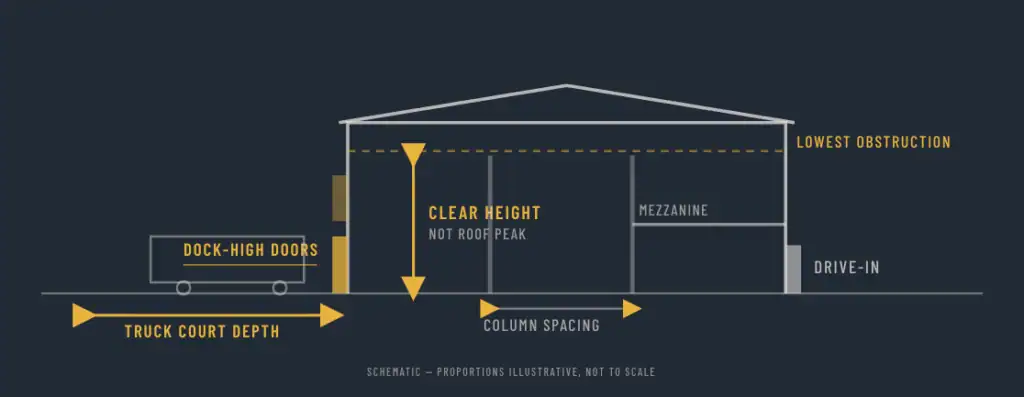
The usable vertical distance beneath the lowest obstruction — not the peak of the roof. Older Madison stock runs low; modern distribution runs much higher. This determines pallet positions per square foot, so a taller building can be cheaper per unit stored even at a higher rate.
Dock-high doors serve trailers. Drive-in doors serve vehicles and equipment at grade. Most operations need a specific mix, and adding docks later means cutting the building and regrading.
The paved area a semi needs to swing and back into a dock. Too shallow and a 53-foot trailer physically cannot make the turn.
Determines whether your racking layout and forklift aisles actually work. Tight columns in an older building can waste a large share of the floor.
Amperage and three-phase availability. Upgrading service is not a small job — the utility's timeline and cost can run well beyond what a tenant expects.
Racking, heavy equipment and machinery all have limits. Older slabs frequently aren't rated for modern loads.
Your fire protection has to match what you're storing. Plastics, aerosols and certain packaging classifications require more capable systems than a standard wet pipe design, and retrofitting is expensive.
Often the real constraint. Outdoor storage is frequently a conditional use rather than permitted by right — and a building with plenty of yard you're not allowed to use isn't a building with yard.
Specialty
Flex
Typically a finished front with a functional back. Contractors, distributors, light manufacturers and service businesses all live here. It's the most commonly mismatched product type in the market, because the office-to-warehouse ratio varies enormously and rarely matches what you need out of the box. Ask what the ratio is before you tour.
Mezzanine
A mezzanine adds usable floor area inside the existing shell — storage, office, or production support — without expanding the footprint. On a building with good clear height it's often the cheapest space you'll ever get. Worth knowing whether an existing mezzanine is permitted and properly rated, because not all of them are.
Industrial is the property type where owner-occupancy makes the most sense most often. Operations are sticky — once racking, dock equipment, compressed air and three-phase service are in, moving is genuinely expensive. If you're going to be somewhere ten years, you may as well own it.SBA financing exists specifically for owner-users buying the building they operate from, with lower down payment requirements than conventional commercial lending, subject to occupying enough of the space. Worth a conversation with a commercial lender early, because it changes what you can afford.
Adding power isn't a contractor call, it's a utility project. Get the timeline in writing before you commit.
Prior manufacturing means prior chemicals. A Phase I is non-negotiable on any building with an industrial past, and a Phase II finding can end a deal.
Madison's industrial districts treat uses differently — some operations that seem obviously industrial still require a conditional use. Outdoor storage, truck parking and certain processing uses are the usual triggers.
Most industrial leases here are NNN. Taxes, insurance and CAM come on top of the quoted rate, and on a large footprint that's a significant number.
If you're growing, a right of first refusal on the adjacent bay is cheap now and expensive later.
Office build-out, mezzanine, mechanical rooms and column footprints all come out of what you can actually rack.
Frequently Asked Questions
Industrial in Dane County is typically quoted triple net, meaning the rate you see doesn’t include taxes, insurance or common area maintenance. Rates vary by clear height, dock configuration, age and location — modern high-clear product near the interstate commands a premium over older in-town stock. We’ll build the fully loaded number for anything you’re considering.
It depends on whether you’re stacking. If you’re racking pallets, more height means more storage per square foot and often a lower effective cost. If you’re running machinery or doing assembly at grade, height beyond what your equipment needs is mostly wasted rent. We’ll work through it with you.
Flex combines finished office with warehouse in one building. Straight industrial is predominantly warehouse or production with minimal office. The distinction matters for rate, for zoning, and for whether the space actually fits how your business operates day to day.
Frequently. Industrial is the property type where off-market activity is most common in Dane County — owners often talk to brokers before they market. If you give us the requirement, we can approach owners in the corridors and parks you want directly.
If your operation is stable and you expect to be in place a long time, buying is worth modeling — SBA financing makes it achievable for many owner-users, and it converts rent into equity. Leasing preserves capital and flexibility. We’ll run both.
Madison and all of Dane County — including Cottage Grove, Sun Prairie, DeForest, Middleton, Verona, Fitchburg, Monona, Waunakee, Oregon and Stoughton — plus industrial transactions in surrounding Wisconsin counties.
Send us the requirement — square footage, clear height, dock count, power, yard needs and timeline. We'll work the listed market and go direct to owners at the same time.